
Quantum Repeaters and Long-Distance Communication
Overview Video – Learning Material – Exercises – Further Information & Literature – Quiz
If you are unsure about any terms, you can always check the glossary.
Overview Video
Learning Material
In the previous section we talked about secure quantum key distribution between Alice and Bob. The focus was on the security of communication. We have seen that the principles of quantum physics can be used to provide a theoretically secure communication between two communicating partners. The question now is whether communication between two distant locations is possible. A single photon has to be amplified to maintain communication over long distances. The no-cloning theorem tells us that it is not possible to clone quantum objects. A “simple” amplification does not seem possible. In classical communication, repeaters are used. The same concept exists in quantum physics.
We are talking about entanglement. Multiple quantum objects can be entangled. They are connected in a very particular way to each other and cannot be described as individual uncorrelated systems. This “connection” remains independent of the distance between them. The measurement of one of the entangled quantum objects has an immediate effect on the other quantum object. For example, we have two entangled single photons A and B. If I measure the polarisation in H/V basis of A and get H, the measurement of B will provide V. The measurement results of entangled quantum objects are correlated or anticorrelated. In the case of anticorrelation, if I measure H in A, I measure V in B. If I measure V in A, I measure H in B. If + in A, its – in B and if – in A, its + in B.
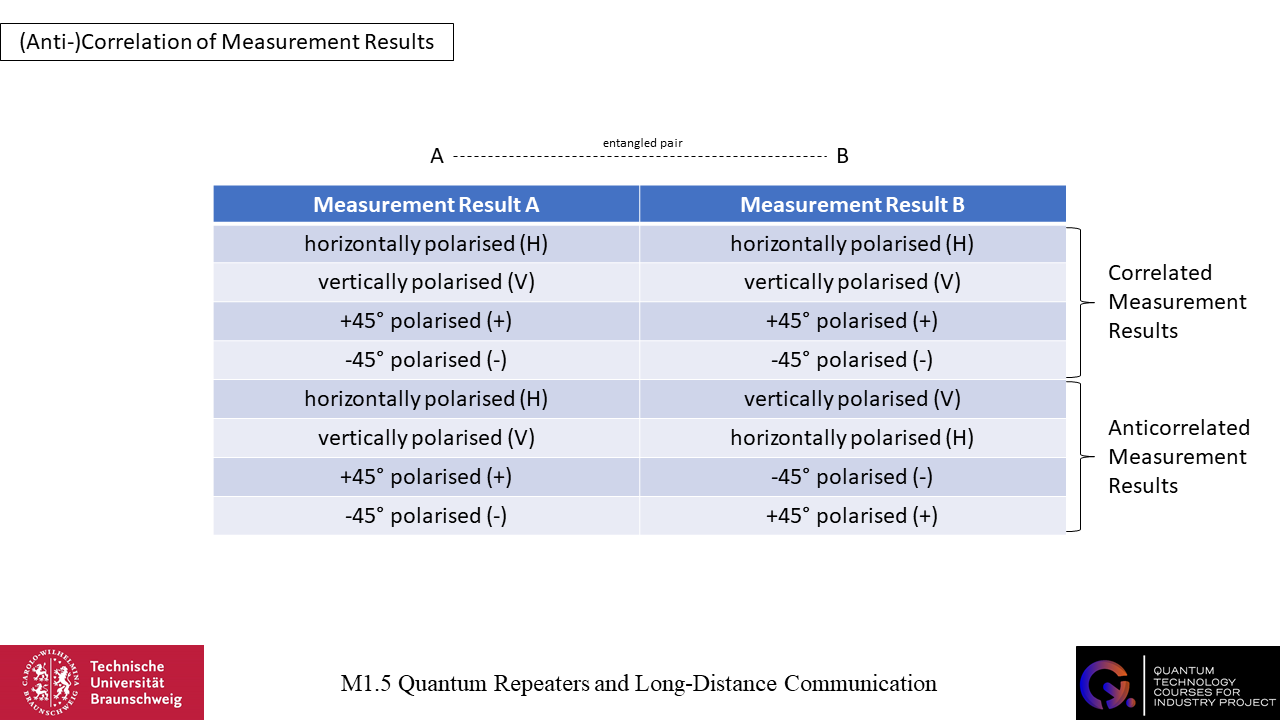
Interestingly, the preparation of entangled photon pairs in one basis concludes the entanglement in the complementary basis too. For example, if we entangle two photons in such a way that they show correlated results in the measurement in H/V basis, they are going to show correlated or anticorrelated measurement results in +/- basis too. The measurement results of entangled pairs are not predetermined, an aspect which lead to many confusion and discussions in the world of physicists. All in all, entanglement is summarised by Basic Rule 5:
Basic Rule 5: Entanglement
Multiple quantum objects can be entangled and be related in a very particular way regardless of spatial position. Entangled quantum objects cannot be described as individual uncorrelated systems.
Let us look at Alice and Bob again. Alice and Bob want to communicate over a long distance, our focus is on bridging the gap. Single photon communication is limited over long distances, the signal will not arrive at the end because of low intensity. We will use the controlled swapping of entanglement through single photons to connect Alice and Bob.
The quantum repeater will play an important role in this process. For the sake of simplicity, we are not going into the details of the mathematical description, but we would rather focus on the theoretical working principles at the core of Quantum Repeaters. We do that using a qualitative approach. The quantum repeater can be thought of as a device that is able to create entangled pairs of single photons, store them like a memory, send them out when needed and perform so-called Bell State Measurements.
A Bell State is a maximally entangled state between two photons. In the procedure that we are going to explain, the Bell State Measurement has a significant role for entanglement swapping. For the qualitative overview, it is not important to understand what the Bell State Measurement is, how it is implemented or what the experimental setup of a Bell State Measurement looks like. For now, we describe it as a black box. The single photons have to arrive at the quantum repeater at the same time, there is done a measurement and the entanglement swapping is completed. To understand this and in particular the meaning of entanglement swapping, let us have a look at some examples:
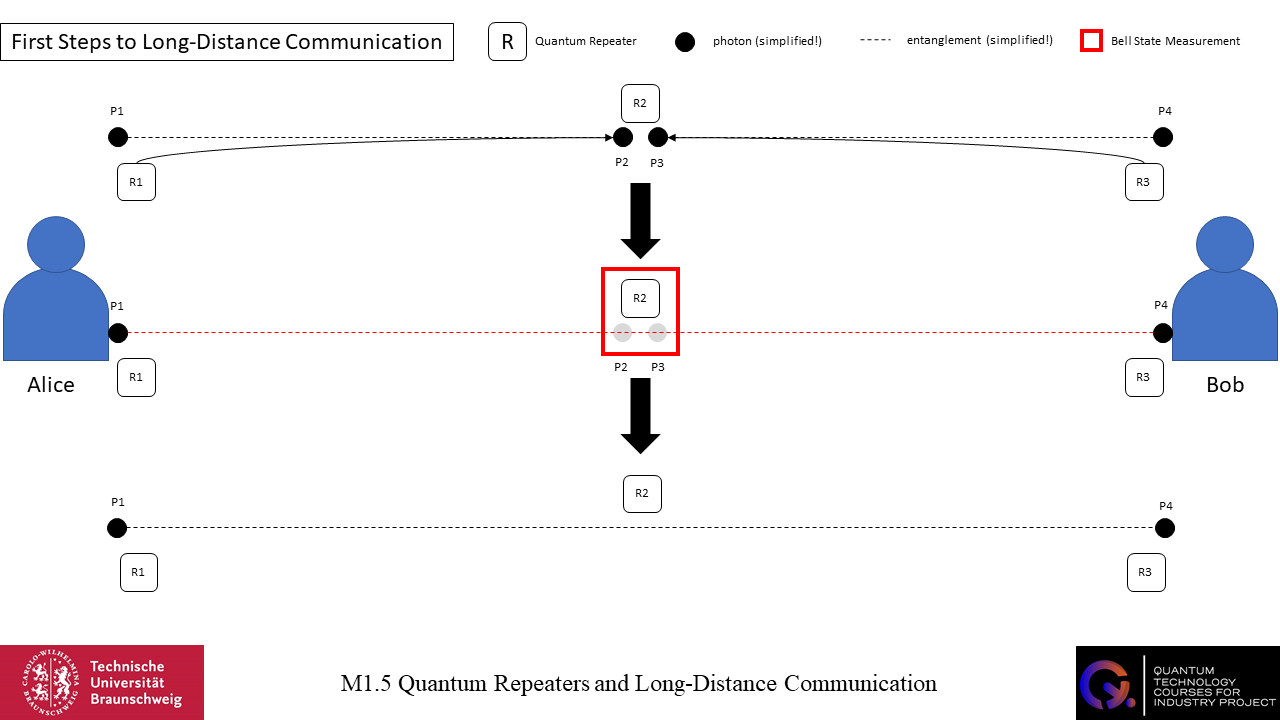
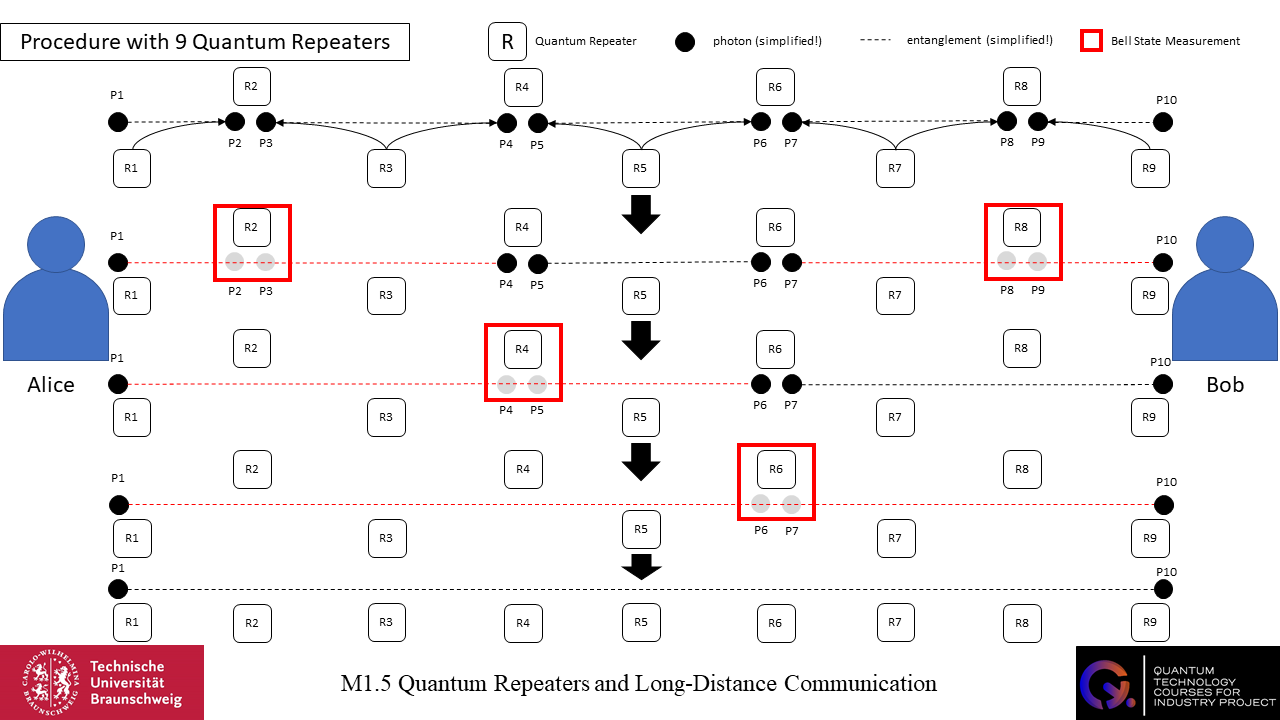
In the first step, we connect Alice and Bob through three quantum repeaters. Alice and Bob have one, and there is also one in the middle of their communication channel. We name them R1 (Repeater at Alice), R2 (Repeater at the mid), R3 (Repeater at Bob). The goal is to establish a connection between Alice and Bob. This means that Alice has a single photon which is entangled to the single photon of Bob. To do this, the quantum repeaters R1 and R3 create a pair of entangled single photons, with R1 creating P1 (photon 1) and P2 (photon 2) and R3 creating P3 (photon 3) and P4 (photon 4). Afterwards P2 and P3 are sent to R2. They (have to) arrive at the same time. At R2 a Bell State Measurement is implemented. As a consequence of the Bell State Measurement the photons P2 and P3 are absorbed/destroyed, they are not important for further considerations. In addition, an entanglement swapping occurs: instead of the initial entangled pairs P1-P2 (entangled photon pair created by R1) and P3-P4 (entangled photon pair created by R3), we now have the entangled pair P1-P4; the entanglement “has swapped“ from P1-P2 to P1-P4. Now that P1 and P4 are entangled, Alice (P1) and Bob (P4) are connected through entanglement.
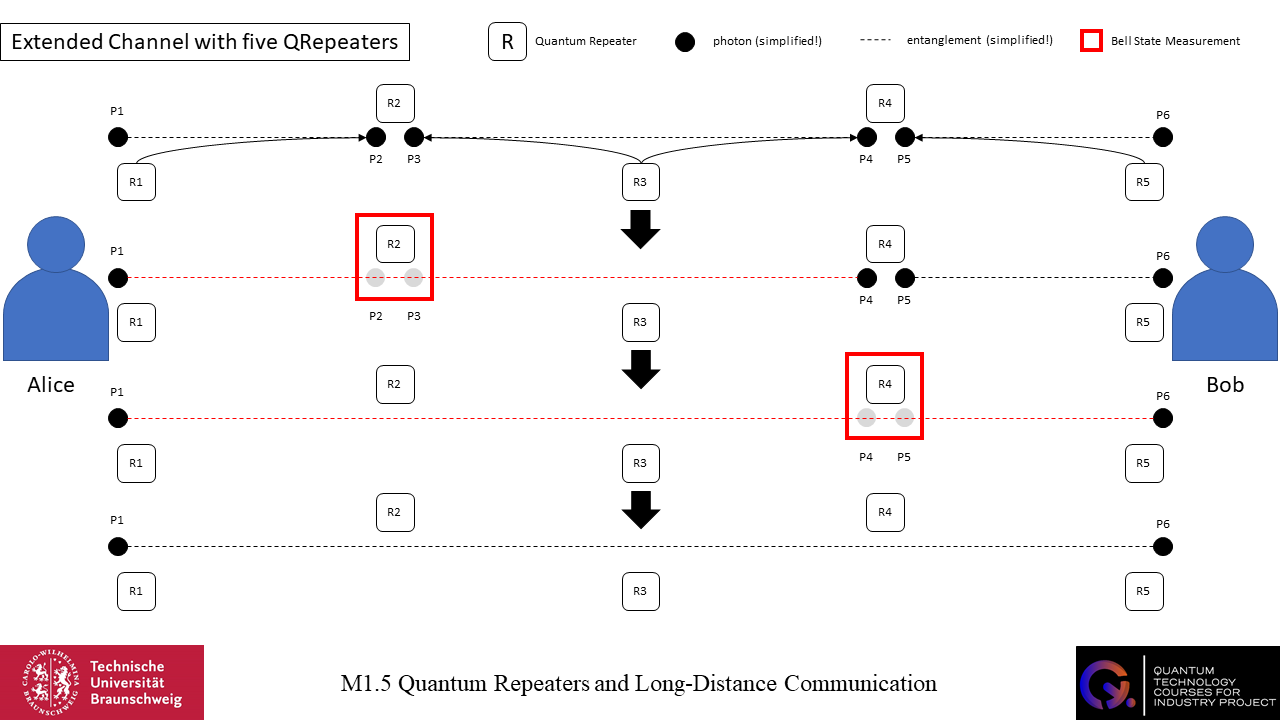
We extend the channel and now need five quantum repeaters. For clarity, the quantum repeaters are numbered from R1 to R5. R1 is Alice, R5 is Bob, and in between are R2, R3 and R4. Again, R1, R3 and R5 create an entangled single photon pair, we name them P1 and P2 (R1), P3 and P4 (R3), P5 and P6 (R5). P2 and P3 are sent to R2, P4 and P5 are sent to R4. The quantum repeater R2 conducts a Bell State Measurement leading to entanglement swapping: now P1 is entangled with P4, P2 and P3 are absorbed/destroyed. However, as you may noticed, there is still no connection between Alice and Bob. The photon P1 at Alice is entangled with P4 at R4. The photon P6 at Bob is entangled with P5 at R4. All in all there is a gap between them. We solve this by doing one more Bell State Measurement at R4. The photons P4 and P5 are absorbed/destroyed and P1 is entangled with P6 as a consequence of entanglement swapping. Alice (P1) and Bob (P6) are connected through entanglement.
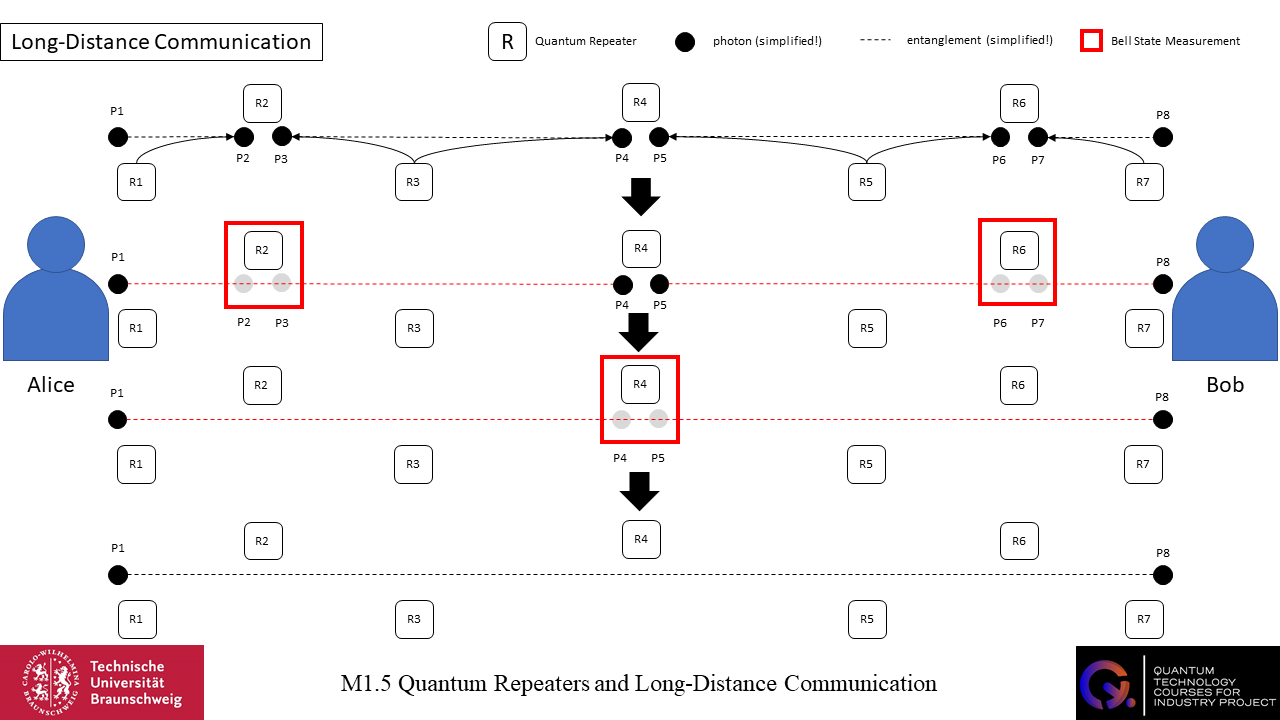
To get a deeper insight, let us look at another example. Again we extend the channel and now need seven quantum repeaters, R1, R2, R3, R4, R5, R6, R7. R1 is Alice and R7 is Bob. The repeaters R2, R4, R6 are going to conduct the Bell State Measurements, the repeaters R1, R3, R5, R7 are going to create entangled photon pairs and send them out. Again we name them P1 and P2 (R1), P3 and P4 (R3), P5 and P6 (R5), P7 and P8 (R7). P2 and P3 are sent to R2, P4 and P5 to R4, P6 and P7 to R6. The quantum repeaters R2 and R4 conduct a Bell State Measurement. Now, P1 is entangled with P4 and P8 is entangled with P5. P2, P3, P6 and P7 are absorbed/destroyed. To connect Alice (P1) and Bob (P8) through entanglement, one last Bell State Measurement at R4 is needed. We conduct this and they are connected.
Once Alice and Bob have entangled pairs of photons, they can exchange states. If Alice makes a measurement on her photon, this will instantanously effect Bob’s photon. Note, however, that the communication is not faster than light. The measurement of Alice does not imply that Bob automatically knows that a measurement has been done, the wave function of the system that contains both photons will collapse but Bob does not “feel“ that. Alice has to tell Bob that she made a measurement. Otherwise, Bob will not be able to do further measurements. In addition, for him his measurement results will appear random. For this reason, the communication between Alice and Bob requires an additional classical channel next to the quantum channel. And the classical channel is limited by the velocity of light.
Throughout this module we had a look into the basic rules of quantum physics. Several interesting phenomena which cannot be found in classical physics and make quantum physics special. The different basic rules were introduced with a variety of relevant problems and application. However, keep in mind that these are very specific application specifically chosen to describe and explain basic rules. This applies for the current topic too. Entanglement has fundamental theoretic implications in the way we understand nature. At the beginning, this counterintuitive phenomena confused the world of physicist and lead to discussions. Nowadays, entanglement can also provide great advantages in the practical realization of quantum technologies. Quantum repeaters and entanglement swapping is a very specific application. Further examples can be found in quantum imaging, sensing, communication and so on!
Exercises
Exercise 1:
Name Basic Rule 5 and explain its meaning.
Exercise 2:
Describe and sketch the procedure for nine quantum repeaters.
Exercise 3:
Two photons A and B are entangled and locally seperated. We measure the H/V polarisation of photon A and afterwards measure the +/- polarisation of photon B. Describe the measurement results you expect and explain your expectation with regard to basic rule 4 and 5.
Solutions:
Further Information & Literature
Repeaters by Quantum Flagship: https://qt.eu/quantum-principles/communication/quantum-repeaters
Azuma, K., Economou, S.E., Elkouss, D., Hilaire, P., Jiang, L., Lo, H.-K. & Tzitrin, I. (2023). Quantum repeaters: From quantum networks to the quantum internet. Online unter: https://doi.org/10.48550/arXiv.2212.10820 . [Stand: 22-09-2023].
Briegel, H.-J., Dür, W., Cirac, J.I. & Zoller, P. (1998). Quantum Repeaters: The Role of Imperfect Local Operations in Quantum Communication. Physical Review Letters, Volume 81, Number 26. pp. 5932-5935.
Müller, R. & Greinert, F. (2024). Quantum Technologies: For Engineers. De Gruyter.