Definite Measurements in Quantum Computing
Overview Video – Learning Material – Exercises – Further Information & Literature – Quiz
If you are unsure about any terms, you can always check the glossary.
Overview Video
Learning Material
In the previous topic we talked about interference and superposition in the context of optical quantum computing. Towards the end of the topic, we realised the Mach-Zehnder interferometer using the Hadamard gate and a phase shifter. Here, the phase shifter had only two states: either it was activated and shifted the incoming waves by a half of their wavelength, or it was deactivated and did not shift. This was helpful in terms of interference, as we focused on the overlap of two possible waves.
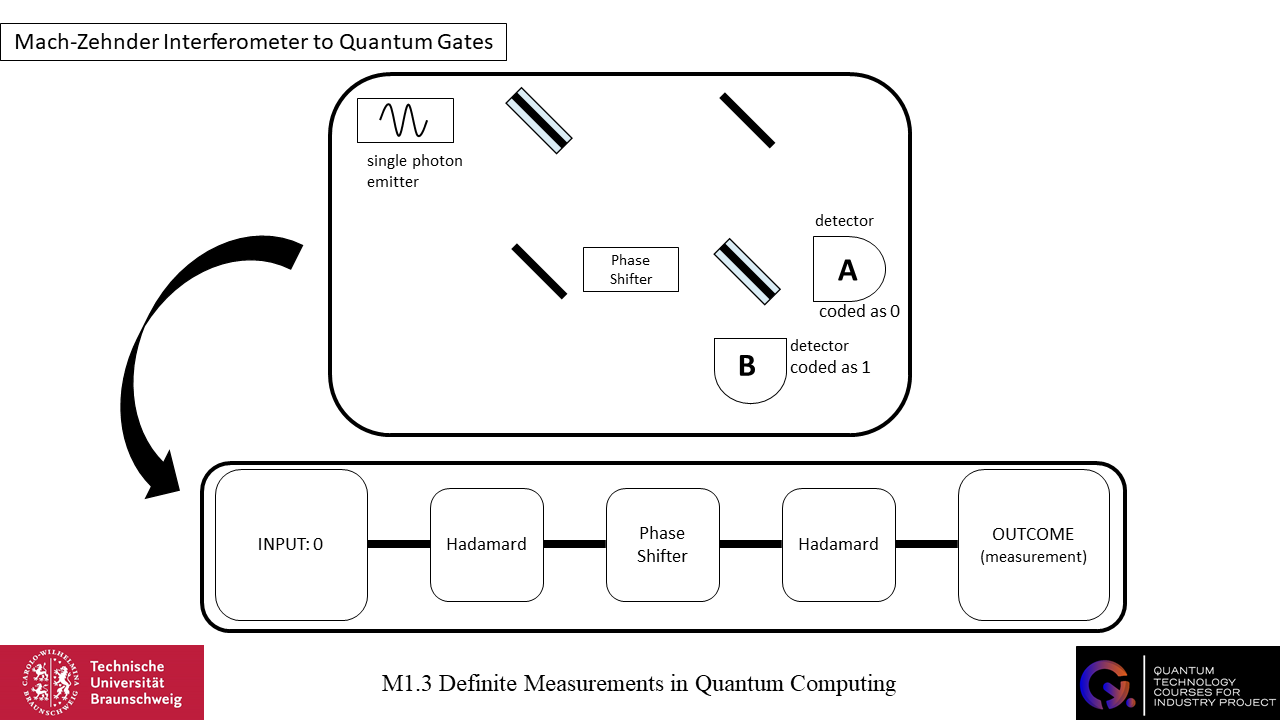
But what happens if we have another phase shift? What do we see when the interference of the waves is not a clear example of amplification-cancellation? And how can we describe quantum objects in this process? We will see in this chapter that in quantum computing, measurement results are still unambiguous and thus usable despite the use of interference.
First, it is important to understand that measurement in quantum physics is fundamentally different from measurement in classical physics. It is an active process that intervenes in the system and affects the further development of the system. In classical physics, measurement means finding a property of the system that has already been determined. Even if we do not measure something in classical physics, it will still have that property because there is no such thing as superposition or other indeterminate or probabilistic properties in classical physics. In quantum physics, objects can be in superposition states and exist in different states at the same time – without being realised in the classical sense. These superposition states can be determined because we can describe mathematically how the quantum object propagates. This process is wavelike. When we measure a quantum object, the superposition state is cancelled and the object has to “decide” for a certain state. The result of the measurement is random – we do not know what the system will “decide” – and is particle-like. The previous topic summarised the first fundamental difference between quantum and classical computing. The second fundamental difference relates to the measurement of quantum states. This is summarised in Basic Rule 3:
Basic Rule 3: Definite Measurement Results
Even if quantum objects in a superposition state need not have a fixed value of the measured quantity, one always finds a definite result upon measurement.
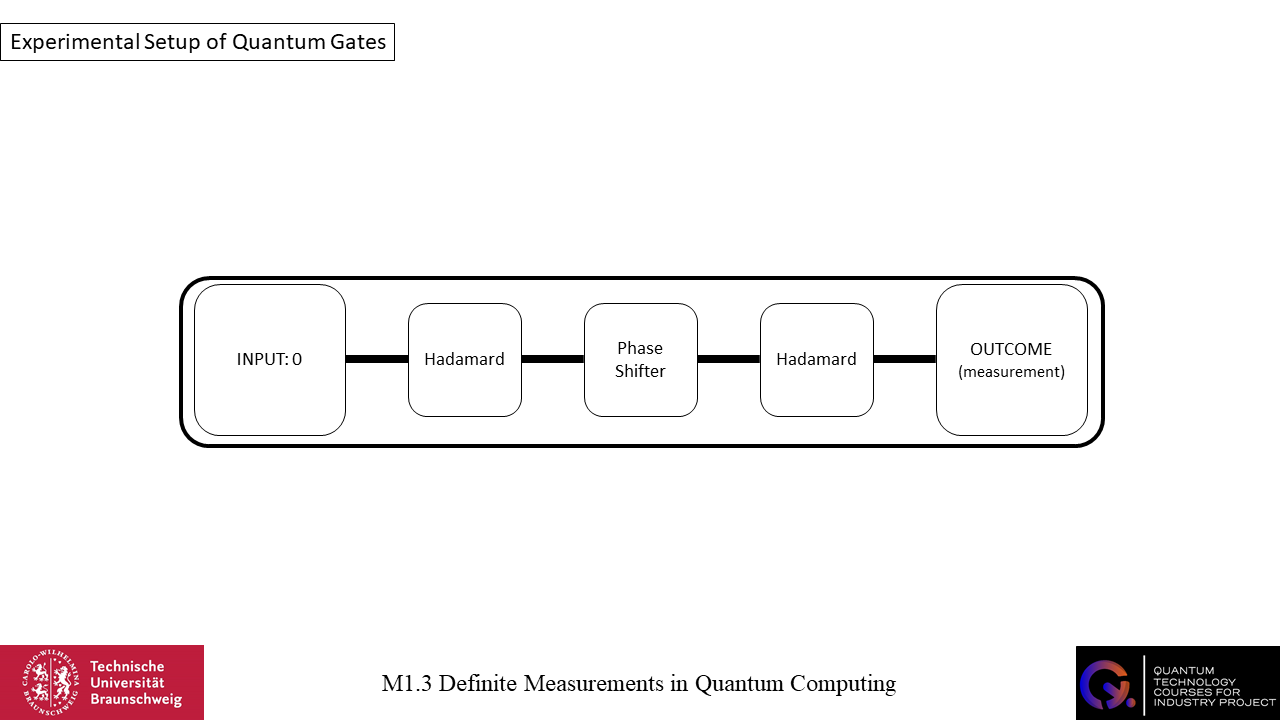
Let us look at the example of the quantum gate structure mentioned earlier. A Hadamard gate, a phase shifter and finally a Hadamard gate are applied to a qubit. With an initial state of  , we can use interference to control the outcome of this setup.
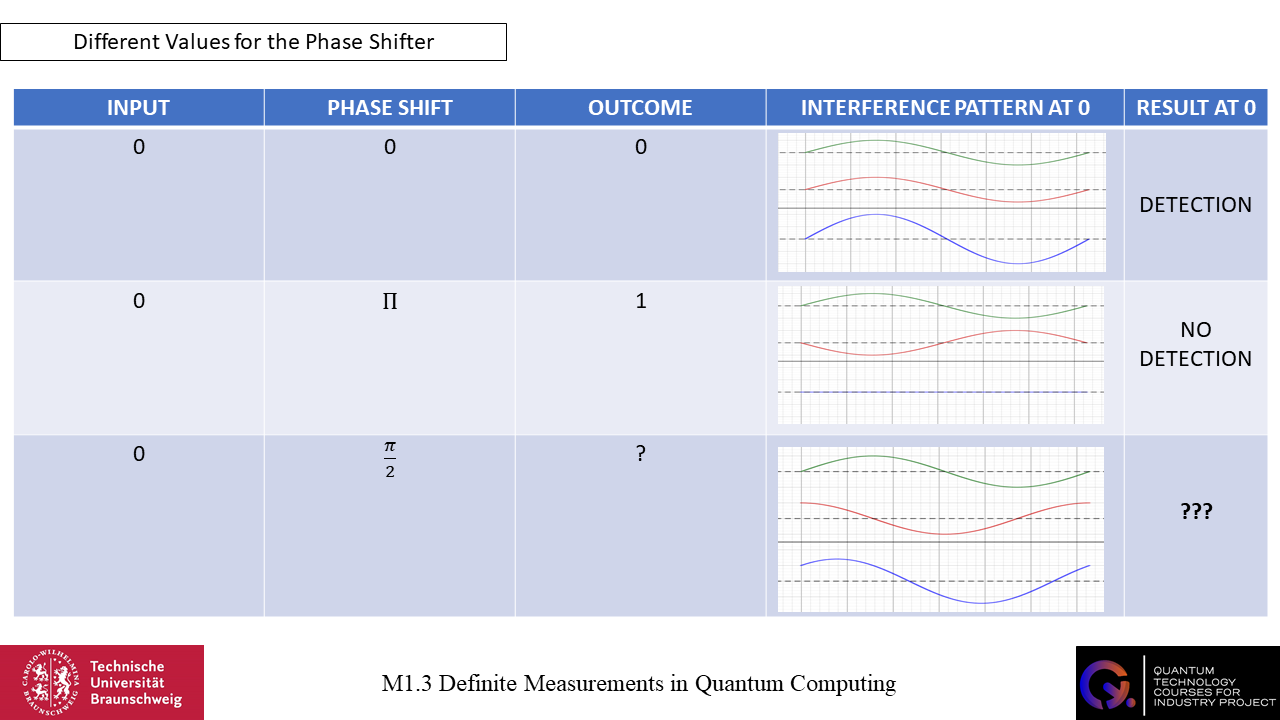
If the phase shift is disabled – i.e. a phase shift of 0 – we measure a due to interference. If the phase shift is activated – i.e. a phase shift of  – we measure a
  due to interference. However, we should remember that there are many more possible phase shifts, the wave can be shifted in an infinite number of ways. So what happens if the phase shift is, say,
  ?
?
Since we are describing the quantum object as wavelike, the wave of the individual quantum object will be shifted by an quarter of its wavelength. The interference pattern will change and the resulting wave will not be a fully amplified wave, but neither will it be a fully cancelled wave. Mathematically speaking, the result is a superposition of and with a 50% probability of and a 50% probability of .
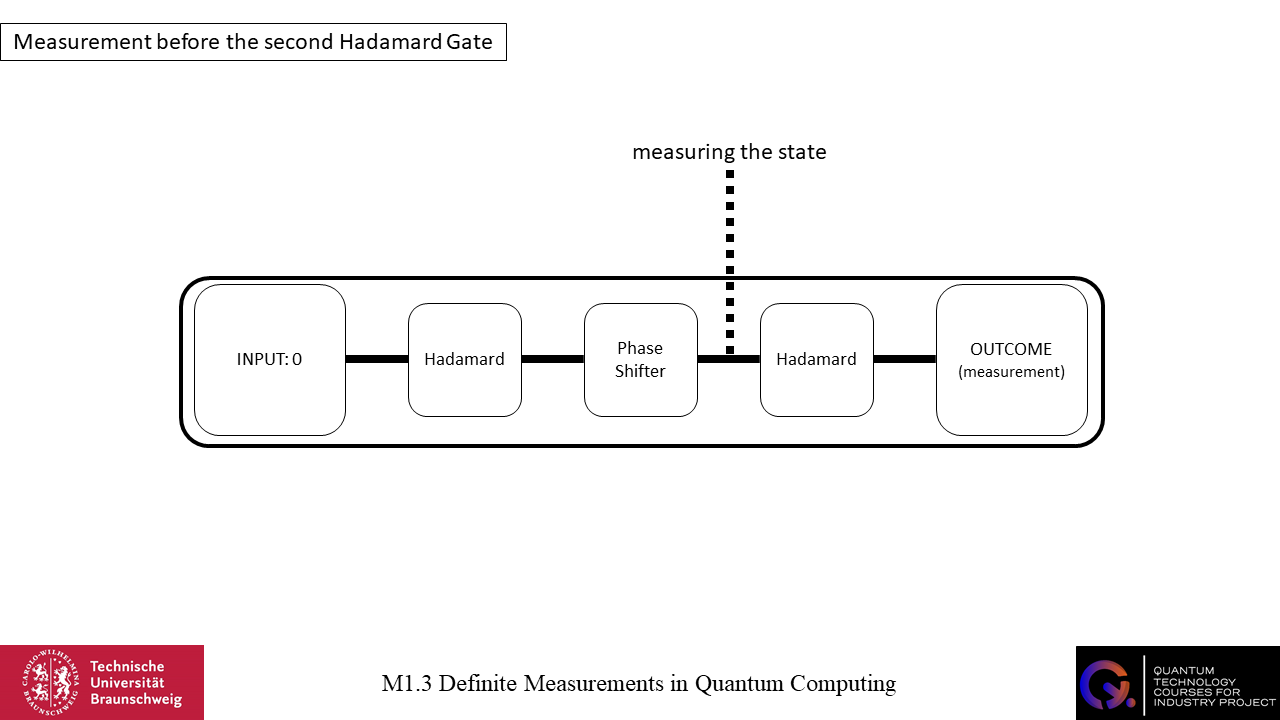
If we now measure the state of the qubit, we will not get something vague that describes this superposition. We will measure or , the result will be random but definite and clear. In the example described, with a phase shift of , we will measure 50% of the time and 50% of the time. However, we will always measure a definite value, either or . The behaviour of the qubit can be described as wavelike for the part where no measurement is taking place – where there is no interaction between the qubit (quantum object) and the environment. Here, the behaviour is fully determined and it is possible to calculate the interference and superposition states of the qubit. During the measurement, the qubit behaves like a particle, but randomly. We measure a definite, unambiguous quantity, but we are not necessarily able to predict the outcome of our measurement, even if it is definite.
All in all, the following rule of thumb describes the behaviour of quantum objects:
A quantum object propagates like a wave and is measured like a particle!
This behaviour emphasises the wave-particle duality of quantum objects and explains why the nature of quantum physics seems so counterintuitive and incomprehensible to us humans.
Exercises
Exercise 1:
Name Basic Rule 3 and explain its meaning. What is the rule of thumb to describe the behaviour of quantum objects?
Exercise 2:
Sketch the experimental setup of the quantum gates mentioned above and explain how the phase shifter changes the experimental result. What will be measured in the end?
Exercise 3:
Watch the Youtube-Video and explain how the observer changes the experimental result and why there is no more interference.
Solutions:
Further Information & Literature
Müller, R. & Greinert, F. (2024). Quantum Technologies: For Engineers. De Gruyter.
Quiz