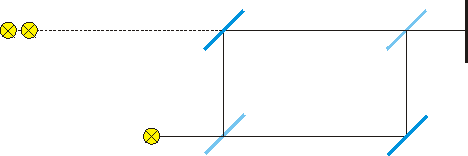
At first glance it is not entirely easy to understand how the interference pattern in the Mach-Zehnder interferometer arises. The following remarks may help to understand the experiment:
- 1. Diverging laser beam
An ideal laser illuminates only a very small spot on the screen. In order to see interference patterns, the beam has to be widened. This is achieved experimentally by means of a lens with a long focal length. The beam of light is therefore not parallel but diverges slightly. - 2. Different path lengths
The interference pattern shown here only arises when the path lengths in the two interferometer arms are slightly different. In practice this is always the case, unless the interferometer is adjusted with great effort. - 3. Construction of the interference pattern
How the interference pattern arises can easily be understood using the following construction: one constructs the mirror images of the light source for both paths and thus obtains an “equivalent beam path”: two light sources on a single axis (fig. below). Because of the different path lengths in the two arms, the two light sources are a small distance apart. This distance is equal to the path-length difference of the two arms.
The superposition of the two beams of light emanating from the “equivalent light sources” produces the circular interference pattern observed on the screen.