
This section provides a brief overview of the applications of the tunnel effect:
Field emission microscope
Source: Das Quantenuniversum, Tony Hey and Patrick Walter, pp. 89ff
The basis of this application is the idea that electrons in a metal can move approximately as if they were in the interior of a potential well. The boundary surfaces of the metal correspond to the walls of the potential well, which the electrons cannot leave without being supplied with energy (cf. photoelectric effect).

Fig. 11.2 Potential model of a metal
If the metal (e. g. a wire or small sphere) is charged so it carries a large negative charge with respect to the surroundings, the form of the potential changes, cf. Fig. 11.3:
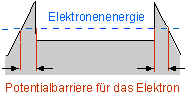
Fig. 11.3 Potential model of a metal with external field
In a vacuum, there is a certain probability that a barrier with this form of potential can be tunneled through by the electrons. Very high field strengths are needed to achieve observable effects, however. This makes very thin metal tips particularly suitable. It was possible to experimentally prove the existence of such a “field emission process” as early as 1928.
This effect is used especially in the field emission microscope. Electrons which have tunneled through the potential barrier are accelerated in an almost straight line in the external electric field (electric field strength of approx.  ). If the needle is surrounded by a phosphorescing screen, a greatly magnified image of the needle tip is obtained, which is composed of the light spots of the impinging electrons. Since the electrons at the corners are the easiest to dislodge, these regions are imaged most brightly.
Diffraction phenomena of the light electrons prevent the resolution from being sufficiently high to resolve individual atoms, however. This resolution can only be achieved when the imaging is carried out not with electrons but with ions, especially helium ions. To do this, the metal tip is positively charged and surrounded by a diluted helium gas. The helium atoms close to the tip release electrons to it. The remaining positive ions are subsequently accelerated in the electric field. This variant is called a field ion microscope.
The magnification of the two field microscopes is many million-fold to a few billion-fold. While structures imaged with the field emission microscope are always blurred, atomic-level resolution is possible with the field ion microscope.
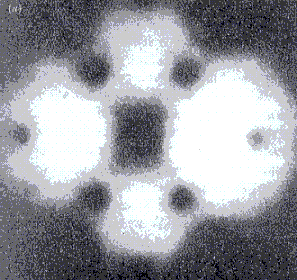
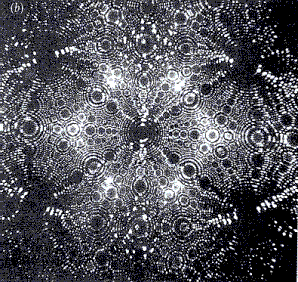
Tungsten needle, imaged with a
a) Field emission microscope b) Field ion microscope
Illustrations from “Das Quantenuniversum”
by T. Hey and P. Walters, p. 91
Scanning tunneling microscope
Source: Largely as per Kuhn Physik 2, p.325 (1st Edition 2000)
A voltage is applied between two conductors which are close to each other, but not in contact. In an ultra-high vacuum, electrons can then tunnel through the potential barrier existing between the conductors. A tunnel current flows whose size decreases exponentially with the width of the potential barrier. This dependence of the tunnel current facilitates the construction of a new type of microscope, whose resolution surpasses that of all previously known microscopes by orders of magnitude. This scanning tunneling microscope, whose invention earned G. Binnig and H. Rohrer the Nobel Prize for Physics in 1986, can be used to image atomic structures directly.
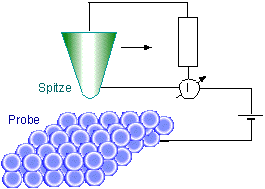
Fig. 11.4: Principle construction of the scanning tunneling microscope

Fig. 11.5: The “smallest hole in the world”: Image of an MoS2 surface in which a single atom is missing, taken with a scanning tunneling microscope (source: W. Heckl, LMU Munich)
To this end, a fine tip scans the surface of the object under investigation. The height of the tip above the surface can be adjusted very accurately. It is set such that a detectable tunnel current flows between the tip and the surface. During the scan, the height of the tip is continuously readjusted such that the tunnel current remains constant. This causes the tip to maintain approximately the same distance from the surface. (Local charge displacements and lattice defects can simulate an incorrect topography.) By recording the tip height for each point, we obtain a height profile of the surface. The method is so sensitive that it is possible to make out individual atoms on the surface.
 -decay
Source: Kuhn Physik 2, p. 368 (1st Edition 2000)
The question now arises: How can an -particle leave the nucleus at all, when its energy is not sufficient to overcome the potential well? – When atoms decay, why not all at the same time?
In the nucleus, the nuclear building blocks (nucleons) experience different forces, which lead to a potential with approximately the following form:
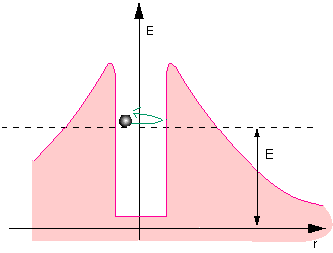
Fig. 11.6: Classical particle in the potential well
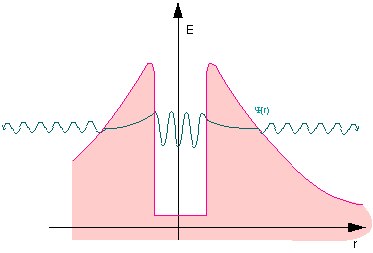
Fig. 11.7: Quantum mechanical particle in the potential well
The tunnel effect explains -decay
All nucleons are attracted to each other by a short-range nuclear force. This leads to the potential well (in the center). The protons electrostatically repel each other, however. Since this force becomes weaker with distance, but does not disappear completely, it gives rise to this potential, which resembles a volcanic crater.
There are species of nuclei where the energy of the individual nucleons in the well is so high that the individual nucleons can exist outside the atomic nucleus as well. The direct path is barred by the potential barrier, however. Being quantum objects, the nucleons with higher energies can tunnel through the barrier. Individual protons can thus vaporize from the atomic nucleus.
Much more frequent that the emission of individual nucleons is the observation of alpha decay, i. e. the emission of a helium nucleus. This is down to the high binding energy of the nucleons in the alpha particle. While the energy of a nucleon in the nucleus is often not sufficient for the free state, the energy can be high enough that a combination of four nucleons can exist in the free state as an alpha particle. In this case, an alpha particle can tunnel out of the atomic nucleus, but not an individual nucleon. How well the wave function of the nucleons or alpha particle can penetrate the barrier is determined by the height and width of the potential. Although the intensity outside the atomic nucleus is low for radioactive nuclei, it is greater than zero. This intensity is also a measure of how easily or quickly nuclei of this species decay.
Sunshine with the aid of the tunnel effect
As is well known, the Sun obtains its energy from nuclear fusion. A total of four protons fuse to form a helium nucleus and several lighter reaction products. Since the nuclear force important for fusion has only a very short range, the charged ions have to approach each other very closely in order to fuse. They therefore require sufficient kinetic energy to overcome the electrostatic repulsion. In this section we use an estimate to show that the ions cannot have the kinetic energy necessary for the temperature in the interior of the Sun and therefore other mechanisms (the tunnel effect) must come into play for the Sun to function in the way we observe.
Estimate of the minimum energy
An elementary fusion process is considered by way of example. Two protons fuse to form one deuterium and several lighter reaction products:
![\[ ^1_1H+^1_1H \rightarrow ^2_1H +^0_1e +^0_0v \]](https://www.milq.info/wp-content/ql-cache/quicklatex.com-7e1bd1d3b115ce7dc2dde2e4b96163c3_l3.png "Rendered by QuickLaTeX.com")
For the protons to be attracted by the nuclear force, the protons have to approach to within the range of the strong interaction. The necessary distance is approx.  ; the protons therefore have to almost make contact. A kinetic energy of approx.
  is required for this (to allow an approach to exactly
  , a kinetic energy of
![\[ E_{\text{kin}}= \frac{1}{4 \pi \epsilon_0} \cdot \frac{e^2}{1.0 \text{fm}} \]](https://www.milq.info/wp-content/ql-cache/quicklatex.com-01540081e015d0f8a63fc1a23c588858_l3.png "Rendered by QuickLaTeX.com")
 is necessary.)
Temperature and minimum energy
For the temperature estimate, the plasma in the interior of the Sun can be assumed to be an ideal gas, whose average kinetic energy is given by:
![\[ \bar{E}_{kin}= \frac{3}{2} kT \]](https://www.milq.info/wp-content/ql-cache/quicklatex.com-8c6ff1d651196a28a74b518c954e2509_l3.png "Rendered by QuickLaTeX.com")
The estimated minimum energy of then corresponds to a temperature of just under  . The temperature in the interior of the Sun of approx. 15 million degrees is lower by a factor of 500, i. e. approx. 3 orders of magnitude. This discrepancy cannot be explained by errors in the estimate.
Since not all particles in a gas have the same energy, it is possible that at least a smaller fraction of the ions reach this critical energy as part of the Maxwell-Boltzmann distribution. The frequency distribution rapidly drops exponentially in the region of interest, however, so that practically no particle in the Sun has the necessary energy. (The difference in the probability density between the most prevalent energy and the minimum energy calculated above is more than 100 orders of magnitude. With approx.  protons, there is a probability of less than
  that the Sun has a suitable high-energy proton.)
The Sun is therefore too cold to be able to obtain its energy from nuclear fusion according to classical theory.
The tunnel effect makes it possible
When two protons move only a little bit closer to one another, they can fuse together with the aid of the tunnel effect: The Coulomb barrier remaining can be surmounted quantum mechanically. The tunneling rate increases, the closer the protons get. Approaches which are sufficiently close are – as estimated above – very rare, however. When the velocity distribution and the tunneling probability are taken into account, the result is that two protons of approximately 5 keV make the most frequent contribution to fusion in our Sun (Gamow peak). For the fusion of 2 nuclei to one
  nucleus and two protons, the maximum is at 21 keV.
So how common or how rare are fusion processes at specific energies?
To be able to estimate this, the degree of transmission (tunneling probability for an approach event) is calculated for the case that two protons approach head-on up to a separation  . The potential
  is the Coulomb potential and the kinetic energy is
  . It is assumed here that the nuclear force is effective below a separation of
  and dominates the electric force.
![\[ T \approx \text{exp} \left( - \frac{2}{ \hbar} \int_{x_0}^x \sqrt{2m(U_{(r)}-U_{(x)})}dr \right) \]](https://www.milq.info/wp-content/ql-cache/quicklatex.com-3ac234460b4e25253ceda45afda5ef73_l3.png "Rendered by QuickLaTeX.com")
In the table below, the associated energies and also the degrees of transmission are given for several minimal separations:
| Separation in 10-12 m | Energy in keV | Tunneling probability | Comment |
| 0.2 | 14 | 9 · 10-7 | |
| 0.5 | 5.8 | 1.6 · 10-10 | approx. energy with max. fusion rate |
| 1.0 | 2.9 | 9 · 10-15 | approx. most frequent particle energy |
| 2.0 | 1.4 | 9 · 10-21 |
The tunneling probability therefore has a very sensitive dependence on the minimal separation achieved. The doubling of the separation already corresponds to a tunneling probability which is reduced by many orders of magnitude.
The values in the table are estimated for head-on collisions. Head-on collisions hardly ever happen in reality, however. At a specific particle energy, the minimum separation is therefore larger and the fusion probability much lower still. Nevertheless, the tunneling effect is absolutely imperative for the Sun’s fusion reactor to work.