
The course presented here is designed so that complex numbers are avoided. Strictly speaking, this is not possible in quantum mechanics, because the wave function is always a complex quantity. For a stationary state (i. e. a state in which the probability density does not change over time), the wave function has the form
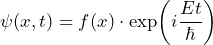 ,
,
which contains the complex exponential function.
Complex numbers, in particular complex exponential functions, can be avoided if one moves as quickly as possible to the stationary Schrödinger equation, which is purely real; the time-dependent exponential factor cancels out during this transition. The time-dependent exponential factor can also be disregarded because it drops out when forming the absolute square:
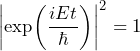
This is the approach chosen in the present teaching concept. The only point at which technical correctness could not be fully maintained is equation (8.1) of the course text. It suggests a real, time-dependent wave function for free electrons.
However, this “cheat” is not very serious. Equation (8.1) is a solution of the Schrödinger equation precisely when  holds. If one is willing to tacitly accept this, one gets by without complex numbers, without sacrificing technical correctness.