
Quantum-Mechanical Calculation of the Energy Levels of the Hydrogen Atom
To solve the Schrödinger equation in the Coulomb potential, one writes it in spherical coordinates. The wave function can then be separated into a radial part and an angular part:

For the radial wave function  , this gives the following equation:
![- \dfrac{\hbar^2}{2m} \dfrac{d^2 u(r)}{dr^2} + \Biggl[ W (r) + \dfrac{\hbar^2 l (l+1)}{2 m r^2} \Biggr] u (r) = E \cdot u (r) \, \text{.}](https://www.milq.info/wp-content/ql-cache/quicklatex.com-9e4fe94f64b9aff848e7e2cba53ebb5c_l3.png "Rendered by QuickLaTeX.com")
Here,  is the Coulomb potential. This equation is an eigenvalue equation (cf. Chapter 8.6), for which, besides the wave function
  , the allowed values of the energy
  also have to be determined. The equation is usually solved using a power-series approach. The resulting solution function is the so-called confluent hypergeometric series.
The decisive point here is: for  the solution function generally diverges. This would mean that the probability of finding the electron at infinity goes to infinity. The eigenvalue problem then has no physically acceptable solution. Only if the condition
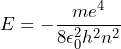
is satisfied does the radial function go to zero for . The fact that not all energies are possible in the hydrogen atom (because of the quantization of energy) is therefore a consequence of the physically required boundary conditions (here: the solution must go to zero at infinity). This is entirely analogous to the infinitely high potential well, where the solution must become zero at the edge of the well.
In general, then, the following statement holds: the quantization of energy is a consequence of the boundary conditions imposed on the wave function.