
Overview of the Treatment of the Hydrogen Atom in School Textbooks
Nearly all of the textbooks listed below discuss the hydrogen atom using the Bohr model. Nowadays, however, a “wave-mechanical” derivation of the energy levels is also common. In what follows, we give a commented overview of the various approaches. No judgement is made here about the quality of the presentation. The following main groups can be distinguished:
1. Heisenberg’s Uncertainty Relation and Energy Minimization
[1] F. Dorn, F. Bader, Physik – Oberstufe, Gesamtband 12/13, Schroedel Schulbuchverlag, Hannover, 1984
[2] W. Kuhn, Physik II, Westermann Verlag, Braunschweig, 2000.
[3] Hammer, Knauth, Kühnel, Physik Leistungskurs, Oldenbourg, München, 1984.
[4] A. Brachner, R. Fichtner, Quantenmechanik, Schroedel Schulbuchverlag, Hannover 1984.
[5] A. Gabriel, W.-D. Garber, Möglichkeiten zur Behandlung des Wasserstoff-Atoms in der Schule, Physik und Didaktik 9 (4), 273 (1981).
In its shortest form, the argument can be presented as follows (quoted from: K. Gottfried, V. F. Weisskopf, Concepts of Particle Physics Vol. I, Clarendon Press, Oxford, 1984): “We can estimate the size of the hydrogen atom by expressing its energy in terms of the position and momentum uncertainties:
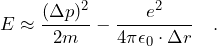
Since

, we can regard this as a function of  alone. Minimizing it, we find for :

This is the Bohr radius; it represents the approximate characteristic size of most atomic states.”
This “quick and dirty” argument is acceptable as long as it is made clear that it is an estimate rather than an attempt at a rigorous derivation. (See also the discussion in Gabriel and Garber (Ref. [5]) as well as R. Müller, H. Wiesner, Stabilität und Spektrum der Atome, Physik in der Schule 34, 48 (1996)).
2. Analogy with a Fixed String
[6] Sexl, Kühnelt, Stadler, Jakesch, Physik 4, Verlag, Hölder-Pichler-Tempsky, Wien, 1992.
[7] D. Ebert u. a., Physik Sekundarstufe 2, Volk und Wissen, Berlin, 1995.
The states of the electrons in the hydrogen atom are treated in analogy to the normal modes of a fixed string. For this, the previously introduced concept of the de Broglie wavelength is used. One frequently encounters the image of a “standing wave around the atomic nucleus”.
3. Separation of Kinetic and Potential Energy
[8] Impulse Physik 2, Ernst Klett Verlag, Stuttgart, 1997
[9] A. Berg et al. Einführung in die Quantenphysik (Berliner Konzept), Berlin, ca. 1990
Here, kinetic and potential energy are considered separately. To estimate the kinetic energy, the electron is confined to a three-dimensional potential well of size  . It is argued that the total energy is then equal to the kinetic energy. The potential (Coulomb) energy at
  is then added to this. The sum of both terms is minimized as a function of
  , which leads to
  .
.
This approach, however, gives rise to substantive problems, since the total energy of an electron confined in a potential well cannot simply be interpreted as kinetic energy.
4. Stating the Ground-State Wave Function
[10] O. Höfling, Physik, Dümmler Verlag, Bonn, 1990.
[11] A. Müller, E. Leitner, W. Dilg, Physik Leistungskurs 3. Semester, Ehrenwirt, München, 1983.
[12] J. Grehn, J. Krause (Hrsg.): Metzler Physik, Schroedel Verlag Hannover, 1998.
The Schrödinger equation is mentioned (in Höfling: the stationary Schrödinger equation is made plausible) and presented as the fundamental equation of quantum mechanics. The probability density (i.e. the squared modulus of the wave function) is then stated (Metzler: calculated) for an electron in the ground state and discussed. This is followed by the introduction of the concept of the orbital.