
Averaging the Coulomb Potential over a Sphere of Radius R
A more exact method of adjusting the depth of the potential well consists in averaging the Coulomb potential  over a sphere of radius
  .
.
Inside the potential well, the potential has a constant value  . The potential well approximates the Coulomb potential best if is chosen so that it represents the “average depth” of the Coulomb potential. To this end, one calculates the mean value
  of the Coulomb potential over a sphere of radius .
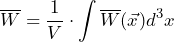
Here  is the volume of the sphere. Substituting
 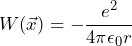 and writing out the volume element gives:
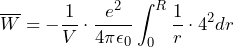
Evaluating the integral: 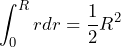 . This gives the mean energy
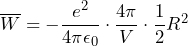 .
.
Finally, must be substituted. The result is:
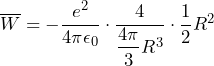
or
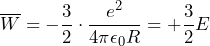 .
.
With this relation, 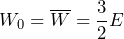 , the depth of the potential well (i.e. the position of the bottom of the potential well below the zero level) is fixed.
The mathematics used here is somewhat complicated, since it involves a three-dimensional volume integral. In order to use the method presented here in the classroom, this elaborate mathematics has to be avoided. One possible way of doing so is shown below.
The sphere is divided into individual spherical shells of thickness  (see figure). For small , the volume of a spherical shell is
  . Since the Coulomb potential is spherically symmetric, it is constant within each spherical shell (provided is small enough) and has the value
  .
.
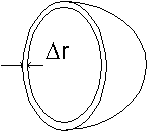
The mean value is now calculated over all spherical shells, weighted by the volume of each shell:
 .
.
Writing out the Coulomb potential and  gives:
 .
.
Pulling the constant terms out of the sum and cancelling  :
:
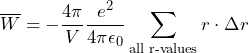 .
.
In the limit  , this is exactly the definition of the integral:
 .
.
Substituting :
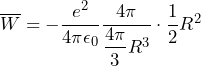 .
.
Cancelling finally leads to the result:
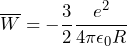 .
.
In this way, the use of volume integrals can be avoided.