
When the results of the photocell experiment are evaluated, one might at first assume that the energy of the electrons should be reduced by the amount of the work function  of the cathode. However, it turns out that this is not the case:
In total, the electrons have to overcome a retarding voltage that is made up of at least two parts. On the one hand, the work function mentioned above must be overcome, and on the other the contact voltages of the metals in the circuit. Between the anode material and the cathode material, however, a contact voltage arises that corresponds to the difference  . When the two parts of the retarding voltage are combined, is eliminated and a term remains that is determined by the work function
  of the anode:
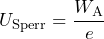
Further metal junctions in the circuit can make additional contributions.
The reason why this difference between and often goes unnoticed is that evaporating cathode material contaminates the anode, so that the work functions of the two metals become very similar.
If one restricts oneself experimentally to determining h, the exact value is unimportant, since it is eliminated as a constant contribution when the difference is taken.
If the work function is actually to be determined experimentally, you can find more details in:
J. Strnad: Die Austrittsarbeit beim Photoeffekt. In: Praxis der Naturwissenschaften – Physik. Heft 11/29. Jg. November 1980. S. 343f
or also:
R. von Baltz; F. Herrmann und M. Pohlig: Der photoelektrische Effekt. Altlasten der Physik (115). In: Praxis der Naturwissenschaften – Physik. Heft 6/58. Jg. September 2009. S. 47-49.