
11.1 The tunnel effect – 11.2 Progress check – 11.3 Summary of Chapter 11: The tunnel effect – –
“In the quantum world, it is possible to quickly sneak through an energetically forbidden zone.” (Richard Feynman)
This chapter deals with the quantum theoretical background of this citation. The Nobel Prize for Binnig and Rohrer in 1986 puts the scanning tunneling microscope at the center of the applications of the tunnel effect.
This chapter contains the fundamentals of, and general information on the tunnel effect, but also makes proposals as to how the tunnel effect can be discussed in schools.
11.1 The tunnel effect
The potential well, in which the electrons are in bound states, was considered in Section 10.1. The potential barrier emerges from the potential well by reflection about the horizontal axis (cf. Fig. 11.1). The potential barrier causes the quantum objects to behave in a completely different way than is the case with the potential well. The bound states with quantized energy levels are missing, for example.
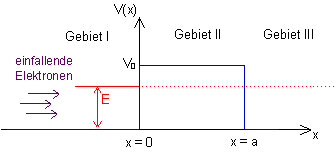
Fig. 11.1: Potential curve  and total energy
In classical physics, the barrier is an obstacle for any particle, and it cannot be overcome if the total energy  of the particle is less than the height
  of the barrier. The situation is different in quantum mechanics:
A wave coming in from the left is partially reflected, but the remainder passes through the barrier into region III. This happens although region II is forbidden for the quantum object from an energy point of view. The solution of the Schrödinger equation provides more details:
The Schrödinger equation for the potential barrier and its solution
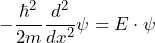
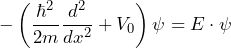
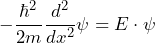
The Schrödinger equation
![\[ \left( \hat{E}_{kin} + V_{(x)} \right) \psi_{(x)} = E \cdot \psi_{(x)} \]](https://www.milq.info/wp-content/ql-cache/quicklatex.com-edd0694866af1efab205471abb140d64_l3.png "Rendered by QuickLaTeX.com")
in regions I, II and III is:
| Region I | Region II | Region III |
 |
 |
 |
rearranged: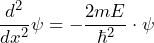 |
rearranged: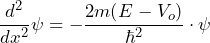 |
rearranged: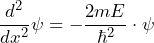 |
Each of the equations has two independent solution functions. To obtain a solution for the whole region, the parts of the solution have to be suitably combined so that the transitions are continuous and continuously differentiable. One of the possible overall solutions has the following form:

with
![\[ k_1 = \frac{1}{\hbar} \sqrt{2mE} \hspace{15pt} \text{and} \hspace{15pt} k_2 = \frac{1}{\hbar} \sqrt{2m(V_0-E)} \]](https://www.milq.info/wp-content/ql-cache/quicklatex.com-17a771edbc400f054fa1cfb952fa15a7_l3.png "Rendered by QuickLaTeX.com")
Here, only the exponentially decreasing partial solution has been used for region II. In this case, the intensity in region III is only a fraction of the intensity in region I. To a good approximation, this low intensity in region III can be considered as that part of the main wave of region I which has tunneled through.
Why is this only an approximation?
To determine the degree of transmission T, the intensities (squares of the absolute value of the wave function) of the corresponding regions are determined and expressed as a ratio. For the wave function stated above we obtain:
![\[ \displaystyle{ T = e^{- \sqrt{2m(V_0-E)} \frac{2a}{\hbar}}} \]](https://www.milq.info/wp-content/ql-cache/quicklatex.com-089f36b775f078f067b631a3a1ed81af_l3.png "Rendered by QuickLaTeX.com")
The degree of transmission  is a measure of how well the barrier can be tunneled through: The higher the barrier compared to the total energy, the lower is the probability that the barrier is tunneled through.
The tunnel effect in nature and technology
11.2 Progress check
After working through Chapter 11, you should be able to answer the following questions:
- What is the Schrödinger equation for the three regions of the potential barrier?
- Which approach is used for the solution? What does the transmission coefficient state and what does it depend on?
- What do we mean by the tunnel effect?
- How does
1. the field emission microscope,
2. the scanning tunneling microscope work? - How can
 -decay be explained?
 - Which possibilities exist in schools to illustrate the tunnel effect?
11.3 Summary of Chapter 11: The tunnel effect
The tunnel effect states that particles can pass through energetically forbidden zones. The degree of transmission can be estimated via the solution of the stationary Schrödinger equation:
![\[ T = e^{- \sqrt{2m(V_0-E)} \frac{2a}{\hbar}} \]](https://www.milq.info/wp-content/ql-cache/quicklatex.com-c4c54ac8dfe201d50aa23f1a2f46a901_l3.png "Rendered by QuickLaTeX.com")
Strong electric fields enable electrons to tunnel from a metal into an energetically allowed region of the field (application: field emission microscope).
Electrons can similarly tunnel through a narrow slit from one metal into another metal (application: scanning tunneling microscope).
In -decay, the tunneling objects are -particles which are emitted by the nucleus with a certain probability.
The tunnel effect can be illustrated with the aid of the total internal reflection of light or microwaves.