
These examples have been kindly provided by Dr. Felix Schumacher from Essen.
Periodic boundary conditions
The six p-electrons in a benzene ring (C6H6) form a system of three conjugated double bonds that are ultimately completely delocalized, i.e., in the language of chemists, smeared out over the whole molecule. The wave functions of these electrons have a nodal plane in the plane of the molecule, and in what follows we shall only consider the behaviour along the benzene ring; this then genuinely gives a one-dimensional problem. This yields the following eigenfunctions ( is the as yet unknown circumference of the benzene ring):
States of even parity:

States of odd parity:

Ground state:

For definiteness, one can imagine that  is the distance of the electron from a particular C atom, measured along the benzene ring. The wave function must then have the period .
In what follows, we shall estimate the circumference of the benzene ring, i. e. the quantity . Apart from the ground state, all states are doubly degenerate. Taking the Pauli principle into account and including spin, the electron state with  is occupied by two electrons and the state with
  by four. The first excitation occurs from to
  .
.
Because of the periodic boundary condition, it must additionally hold that:

The energy eigenvalues are as follows:
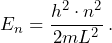
The corresponding energy difference is therefore:

Optically, this transition lies in the near UV at  nm; setting

Under the square root there are only natural constants and the measured quantity nm. This allows the circumference of the benzene ring to be determined; one obtains  . The distance between two C atoms in the benzene ring is therefore
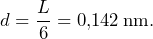
The literature gives  . This is a deviation of only 2%.
For the spatial distribution of the p-electrons along the benzene ring, the model yields a constant probability density. This is typical of an aromatic compound.
An application example for the linear potential well with infinitely high walls are the polyenes, linear carbon-hydrogen compounds with conjugated double bonds. If one considers the p-electrons along the molecule (e. g. β-carotene), it turns out that the probability of finding an electron is greatest at the ends of the molecule. In addition reactions, atoms therefore always attach at the ends of the molecule.