
Why does the solution given only provide an approximation of the tunnel effect?
Here, the Schrödinger equation has been solved over the real numbers. This means that the solution is time-independent, i.e. purely static: the wave function corresponds to that of a standing wave and is therefore, strictly speaking, unsuitable for directly describing transport processes of quantum objects. The term “tunneling through” therefore does not really fit in this context.
In the following, it is shown without calculation how an approximation using standing waves can be constructed from the ansatz for the exact, time-dependent solution. This approximation satisfies the stationary Schrödinger equation, which is easier to solve.
Ansatz for the exact solution:
Quantum objects approach a barrier from the left. The quantum objects are described by a wave function corresponding to a travelling plane wave (a complex harmonic wave). At the barrier, the wave splits into a transmitted and a reflected partial wave. The intensities of the partial waves follow from the fact that the incoming wave and the two outgoing partial waves must satisfy the (time-dependent) Schrödinger equation.
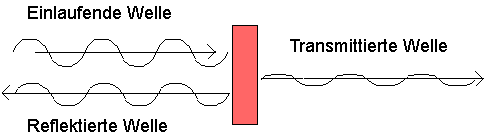
Given the shape of the barrier and the kinetic energy of the quantum objects, the transmission coefficient can thus be calculated exactly as the intensity ratio of the transmitted to the incoming wave.
The time-reversed process:
The Schrödinger equation (both time-dependent and time-independent) has essentially the same solutions when the time axis is reversed, i.e. when time runs backwards. Strictly speaking, under time reversal ( ) the wave function must be replaced by its complex conjugate.
The time-reversed process looks like this: two waves approach the barrier from the left and from the right in such a way that they combine at the barrier into a single wave travelling to the left.
Remark: Intuitively, one might expect that there should also be two outgoing waves here. However, the initial conditions are chosen such that the wave travelling to the right vanishes due to destructive interference.
Superposition of the two processes:
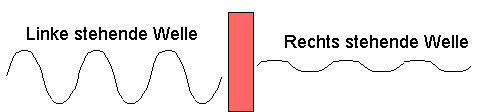
If the two processes are now superposed, pairs of waves travelling in opposite directions are always found, which combine to form standing waves. This makes the problem static. The corresponding wave function therefore solves the stationary Schrödinger equation.
Where does the approximation lie?
In the case of the actual transport process, the transmission coefficient describes the intensity ratio of the transmitted to the incoming wave. This definition cannot be applied directly to the stationary case.
In the case of standing waves, only the intensity ratio between the standing waves to the left and to the right of the barrier can be calculated. The weaker wave on the right can easily be identified with the transmitted wave, while the stronger wave on the left is composed of both the incoming and the reflected wave. The intensity of the left-hand wave (stationary approximation) therefore does not exactly correspond to that of the incoming wave (exact solution). The approximation now consists in approximating the intensity of the incoming wave by that of the standing wave on the left-hand side.
When is the approximation good?
The smaller the difference in intensity between the incoming and the reflected wave, the better the stationary case approximates the transport process. This is equivalent to a good approximation at a high degree of reflection, i.e. a low degree of transmission.