Analogies to the tunnel effect
The information for these explanations is obtained from: “Das Quantenuniversum”, Hey & Walters, pp. 85ff
The tunnel effect with waves:
The tunnel effect can be demonstrated with the aid of the total internal reflection of light. Light whose amplitude attenuates exponentially with the distance from the surface also appears behind the surface which causes total internal reflection. If a second prism is moved towards and parallel to the glass surface giving rise to the total internal reflection of the first prism, and if the distance is such that the “attenuating wave” reaches right to the second prism, we notice a light beam in the second prism. The closer the prisms are to each other, the more light is transmitted, since the amplitude in the forbidden air layer has correspondingly less time to attenuate. This phenomenon is often also called “frustrated total internal reflection”. This phenomenon is nothing more than the quantum mechanical tunnel effect with de Broglie’s matter waves. In optics, this effect is used as a beam splitter to split up the light.
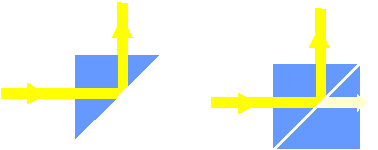
Fig. 11.8: Tunnel effect with total internal reflection
The experiment with light is difficult to carry out in schools. The experiment can be done much more easily with microwaves and paraffin prisms.
Roller coaster model
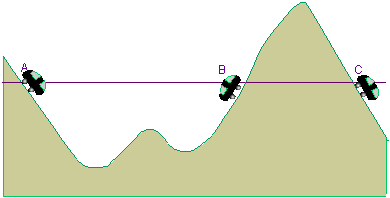
The roller coaster model is a very intuitive explanation of the tunnel effect. A car starts from rest at point  . Energy conservation means it cannot get any higher than point
  . But because of the tunnel effect, there is a probability of finding the car at point
  .
.