
The method in which the Coulomb potential is replaced by a suitably adapted box potential yields the correct  -dependence of the hydrogen energy values:
 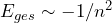 .
.
This raises a question: the energy values of an (ordinary) potential well are proportional to  (cf. Equation
  in the main text). How, then, can a potential-well model yield an energy dependence of
  ?
?
Answer: the parameters of the potential well ( and
and  ) themselves contain the energy
  (cf. Equation
  in the main text). If these energy-dependent parameters are substituted into the energy formula , appears on both sides of the equation. Solving the equation for can then yield a different -dependence than the original
  — and this is exactly what happens here.
This aspect of the method presented is somewhat difficult to see through: in essence, a different potential well is fitted to each value of .
Back to the chapter overview.